Category: art

  • diploria

    diploria


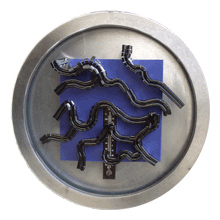
    not exactly a human brain, but brain coral, the “mine canary” of the ocean. Sensitive to changing temperatures and pH as the earth warms.

    plastic c))motion strips move and wave in the sun, shading a thermometer from the rising heat. Seemingly alive. Actually dead. The last gasp of the coral sea.

    by substituting a black plastic film for delicate coral polyp tentacles, we give voice to our fear of substituting artifice for the beauty of nature. Emptiness in lieu of abundance. While the sun ultimately powers all life- even synthetic life arising from mechanical tension between expansion and compression in a plastic film-  life becomes a hollow existence once nature fades away.

    Yet there is always the promise of redemption. In diploria, the same black plastic film mimicking life, was developed to reduce global warming by shading buildings from strong sun. Thus all challenges are ultimately opportunities.

    First exhibited “Sublime Climate”, Cambridge School of Weston, 2008

    diploria
    2007

    Materials:
    galvanized steel frame, 18 ” diameter
    c))motion plastic tendrils
    natural sunlight, or theatrical lights and controller
  • :N:P:K 18:6:12

    :N:P:K 18:6:12

    so it is said.

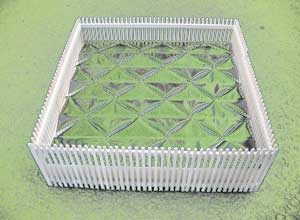
    to run our toes through on a soft summer afternoon. To impress our neighbors. To control and mark our built environment.

    be careful of what you ask for. The cost of a green lawn is measured in dollars today, and a stunning burden on the environment tomorrow. N:P:K 18:6:12 is a “living, breathing” lawn, but one reflecting, like Dorian Gray’s picture, the true price paid for a perfect piece of heaven.

    N:P:K 18:6:12
    2007

    Materials:
    9.5″ x 9.5″x4″
    painted wood fence
    c))motion plastic
    theatrical lights and controller, or full sun
    recorded robin songs, or live birds

  • remanence

    remanence

    remanence sways and reacts to the the natural world around it. It hold a shadow in its arms, slowly releasing its captured darkness to light as the c))motion plastic is reanimated by the sun.

    we are always part of what we try and understand- there can be no distance.

    remanence
    2007

    Materials:
     4’x4′ veneered plywood substrate
     c))motion plastic vanes on twenty five 9″x9″ tiles
     natural sunlight, or theatrical lights and controller
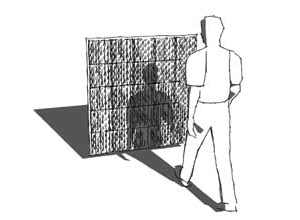
    can be placed on wall or floor in front of a south-facing window

    2024 in the collection of the Boston University Photonics Center

  • e uno plures

    e uno plures

    It seems obvious complex outcomes must arise from complex behaviors.

    Yet nature is parsimonious, building all of life upon a few simple rules.

    Six columns. Six tableaus. Almost insignificant variations and adaptations of one underlying phenomena.


    Constructed from plastic ribbons that bend when heated or exposed to bright light, this piece explores sequentially, visually and dynamically the path from simplicity to apparent intricate purpose.

    Complexity is in the eye of the beholder.

    e uno, plures
    from one- many
    2006

    Materials:
    six veneered wood columns, four foot high
    c))motion plastic
    theatrical lights and controller

    first exhibited, Parsons the New School April 2009

  • 122468

    122468


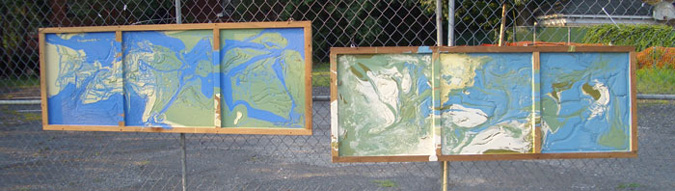
    An island in the cold and vacuum. But that knowledge was intangible.

    Until the Apollo 8 astronauts. They brought emotion to understanding with their now familiar image of earth – a “blue marble” suspended in a black void. Creating an icon for the 60’s, and a symbol of our interdependence as a species.

    Once again, it is a message worth repeating.


    poured latex and oil paint on wood
    two years drying time
    two panels, three frames per panel
    77 1/4″ x 28 1/4″

    1998-2000